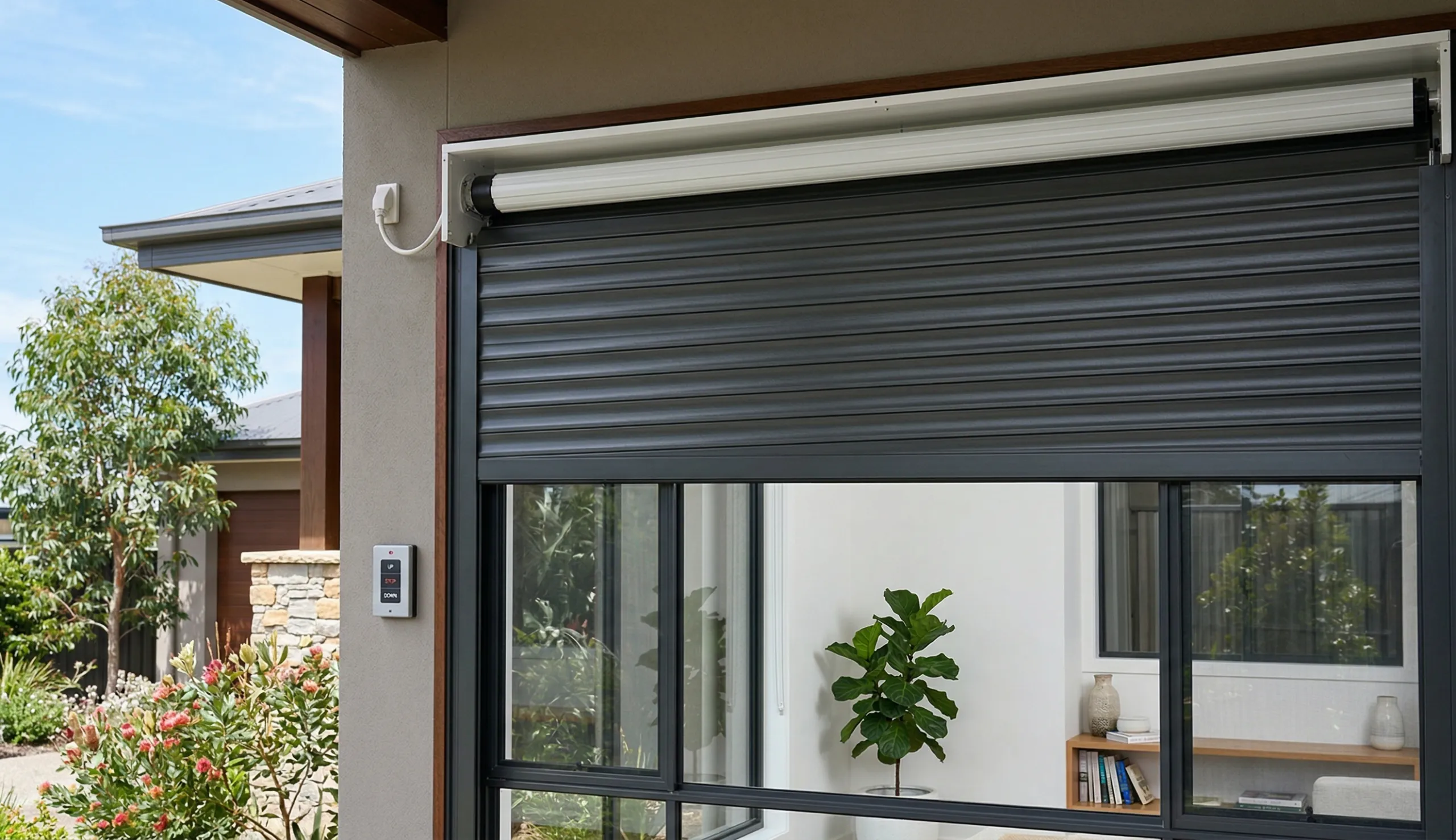
Electric roller shutters (also called motorised roller shutters) cost more, but they are usually easier to operate and can provide better resistance to lifting when correctly installed.
Choosing between manual and electric roller shutters comes down to your budget, the number and size of the openings, and how you want to control them. Both types provide external shading and cover the glass. In Australia, the terms "electric" and "motorised" are used interchangeably for any roller shutter driven by a built-in motor. The practical difference is how they operate day to day.
The comparison below covers costs, security, maintenance and daily use so you can choose what suits your Sydney home.
Manual roller shutters use a winder mechanism, strap or crank handle to raise and lower the curtain. You turn the handle or pull the strap, and the shutter rolls into its headbox above the window.
There is no motor or mains wiring. Spring tension offsets some of the curtain's weight, but wider or heavier shutters still require more effort.
For one or two windows, that is manageable. Across a whole house, operating every shutter by hand each morning and evening can become tedious.
Spring tension is the key component that makes manual operation smooth. When that tension loosens over time, the shutter feels heavier and harder to wind.
A spring tension adjustment usually fixes this without replacing any parts. The Australian Government's YourHome guide notes that effective external shading can block up to 90% of direct solar heat.
Each mechanism has different failure points. Winder boxes can fail when their gears strip, while strap coilers stop working if the spool spring or strap breaks.
Crank mechanisms are usually durable, though their gears and joints still need to turn freely.
Electric roller shutters use a tubular motor installed inside the roller tube at the top of the shutter. Press a wall switch, remote control or phone app, and the motor spins the tube to raise or lower the curtain. The motor draws 240V power through hardwired cabling, which means an electrician needs to run the wiring during installation.
Manufacturers and installers sometimes call these motorised roller shutters rather than electric. The terms mean the same thing. Any roller shutter with a tubular motor inside the roller tube qualifies as motorised.
Battery and solar-powered motors can avoid a new mains cable. Somfy's Australian roller-shutter brochure, for example, lists a battery-powered motor for openings where an electrical connection is difficult. A solar version uses a small panel to charge the motor battery.
A battery or solar motor is worth considering when there is no clean wiring route. The installer will need to match it to the shutter and find a practical position for the panel and battery.
On many electric systems, the drive and locking accessories resist the tube turning when the shutter is down. Good lift resistance comes from the motor, guides and locking parts working together. No roller shutter is burglar-proof.
If a remote, timer or smart control stops responding, the problem is usually in the receiver or pairing rather than the motor. Our guide on troubleshooting a roller shutter timer or smart control covers the common fixes.
If the power goes out, a hardwired motor stops. Some electric shutters include a crank for opening the shutter by hand; others do not. Check the outage procedure before choosing the motor.
Price is where the two types split most clearly. Fix My Shutters' indicative Sydney range for a standard window is $350 to $700 installed for a manual shutter and $800 to $1,600 for an electric shutter.
Large openings, difficult access and new electrical work push the price up. Use the table as a comparison guide and get a site-specific quote before setting the budget.
| Factor | Manual | Electric |
|---|---|---|
| Supply + install (per window) | $350 - $700 | $800 - $1,600 |
| Motor cost | N/A | $250 - $580 |
| Electrical work | Not required | $250 - $550 |
| Annual maintenance | $50 - $100 | $80 - $150 |
| Eventual motor replacement | N/A | $350 - $475 |
| Smart home add-on | Not available | $100 - $250 per hub |
Whole-of-life cost is harder to predict than the installation price. A manual system may need several smaller winder box repairs, while an electric system can face a larger motor replacement. Alignment, shutter weight, frequency of use and maintenance affect both.
Electric shutters often resist forced lifting better because the drive holds the tube and can work with anti-lift devices. The guides, bottom rail and fixings still matter. A poorly fitted electric shutter can be less secure than a well-maintained manual one with suitable locks.
Manual shutters still cover the glass and sit inside guide rails, but the operating mechanism alone may not prevent upward movement. End locks or another suitable locking arrangement can improve resistance.
Security tip: If you have manual shutters and want to improve security without upgrading to electric, consider having a suitable end lock fitted to the bottom rail. It adds useful resistance when the shutter is down.
The ABS Crime Victimisation survey estimated that about 2% of Australian households experienced a break-in and a similar share experienced an attempted break-in. Shutters are only one part of home security, so compare the complete locking system rather than buying on the word "electric" alone.
If you are unsure whether your existing shutters are doing their job, run through a proper roller shutter security check before deciding on an upgrade.
Daily use is where the decision becomes personal. If you have two shutters on bedroom windows, manual winders may add little effort to your day.
Across six or eight windows, the effort adds up. Electric shutters with group control can close compatible shutters together, although larger groups may start in sequence.
Electric shutters also work better for people with mobility limitations, arthritis or reduced grip strength. Manual winder handles require a firm twist, and strap coilers need a strong downward pull. If that is difficult now, it will be worse in five years.
Smart controls can schedule shutters for privacy or operate them in response to a compatible sun or temperature sensor. The Australian Government's guidance on windows and external shading recommends closing coverings during hot days and opening them after sunset when conditions allow. Automation can make that routine easier, but only when the motor, receiver, sensors and control platform are compatible.
If a hardwired shutter loses power, it usually stays where it was when the outage began. That matters most when a shutter covers a door, bedroom egress point or another opening you may need to use.
Some motors have a crank-operated override. Others need backup power or have no user-operated release. Ask the installer for a demonstration and keep the handle where household members can reach it.
If outages are common, compare a manual override, a compatible backup supply and a battery or solar-powered motor before installation. Give extra attention to shutters over doors and other openings the household may need to use. Our guide explains what to check before trying to open a roller shutter without electricity.
A separate issue is when a motorised shutter trips the circuit breaker each time it runs. That points to a wiring or motor fault rather than a mains outage, and needs its own diagnosis.
Bushfire-prone land: A BAL assessment does not make every residential shutter compliant. NSW RFS planning guidance sets the framework for new development, and the required shutter details vary with the assessment and design.
For example, an official BAL-40 specification published by Clarence Valley Council requires a bushfire shutter to be readily operable by hand from inside or outside. Have the certifier or bushfire consultant confirm the requirement for each opening.
Manual shutters have fewer parts, but the operating parts still wear. Common faults include stripped winder gears, damaged straps, tired springs and guide rails that need cleaning or suitable lubrication.
Many manual window roller shutter repairs involve a smaller mechanism rather than a motor. Electric shutters add controls, wiring and a motor, which can make diagnosis and replacement dearer.
Motor life changes with the load, alignment and frequency of use, so a universal age or cycle figure is misleading. Pay closer attention to changes in speed, sound and stopping position.
To understand how long roller shutters last before needing major work, the answer depends more on the quality of the slats and guides than on whether the drive is manual or electric.
Fix My Shutters handles repairs for both manual and electric systems across Sydney. If the fault is not obvious, a roller shutter safety and condition check can identify whether the motor, manual mechanism or curtain needs work.
Often, yes. Converting (or motorising) a manual roller shutter means replacing the manual drive with a compatible tubular motor and fitting its controls. A hardwired motor also needs a suitable power route and licensed electrical work.
The curtain, headbox and guide rails may stay if they are sound and compatible with the motor. Fix My Shutters' indicative Sydney conversion range is $600 to $950 per shutter. Difficult wiring, access or an unusually large shutter can raise that figure.
For a step-by-step walkthrough of what is involved, see our guide to converting a manual roller shutter to electric.
Good to know: Not every manual shutter can be converted. The roller tube and headbox need room for a suitable motor, and the existing curtain and guides must be worth keeping. Limited electrical access, severe corrosion, a damaged headbox or obsolete parts can make replacement the more sensible option.
If you are considering a conversion, have the slats checked for wear at the same time. It is cheaper to replace worn slats during a conversion than as a separate job later.
Yes. Both terms describe a roller shutter powered by a tubular motor. "Motorised" highlights the motor mechanism while "electric" highlights the power source. In Australia you will see both used by manufacturers, installers and in building specifications. There is no performance or feature difference between shutters marketed as motorised versus electric.
A healthy motor normally makes a steady hum, but there is no useful universal decibel figure for every shutter. The curtain size, headbox, fixings and motor model all change the sound. A new grinding, clicking or scraping sound deserves attention; our guide to diagnosing a roller shutter that has become unusually noisy explains the likely causes.
The motor uses its main power while the shutter is moving, and each run is brief. Check the rated input on the product data sheet and allow for any smart hub or receiver that remains on standby.
Possibly. Start with the motor model and its control protocol; a remote control by itself does not prove that a Wi-Fi bridge will work. Check the bridge's supported apps and safety functions before buying it.
Motor life varies too much for one age or cycle figure to be useful. Correct sizing and alignment help, but changes in speed, stopping position, temperature or sound are better reasons to book an inspection.
Conversion can be worthwhile when the curtain, guides and headbox are sound and the motor and wiring can be fitted cleanly. Ask for both conversion and replacement options if several major parts are already worn.
Keeping a poor curtain to save on the motorisation quote often shifts the repair bill into the next few years.
Yes. Motorisation is done per shutter, so you can convert a single opening and leave the rest manual. This is common when one shutter covers a large or hard-to-reach window, or when a household member has reduced grip strength on that side of the house. The motor, wiring and controls are fitted to that shutter only.
No reliable percentage can be attached to the sale value of a Sydney home. Working shutters may appeal to buyers who value external shading, privacy and easy operation, while damaged or obsolete systems can look like another repair bill. Choose the operating type for the household rather than chasing a promised resale return.
If you are covering one or two windows and budget matters most, manual roller shutters do the job well. They are cheaper, simpler and reliable enough for small setups.
For several windows, reduced grip or mobility, or grouped and scheduled control, a motorised system is usually easier to live with. The upfront cost is higher, and you need a clear plan for power outages and eventual motor repairs.
Fix My Shutters repairs, motorises and services both manual and electric roller shutters across Sydney, including Parramatta and Blacktown. If you are still weighing up repair, conversion or replacement, get in touch for an assessment and quote.
