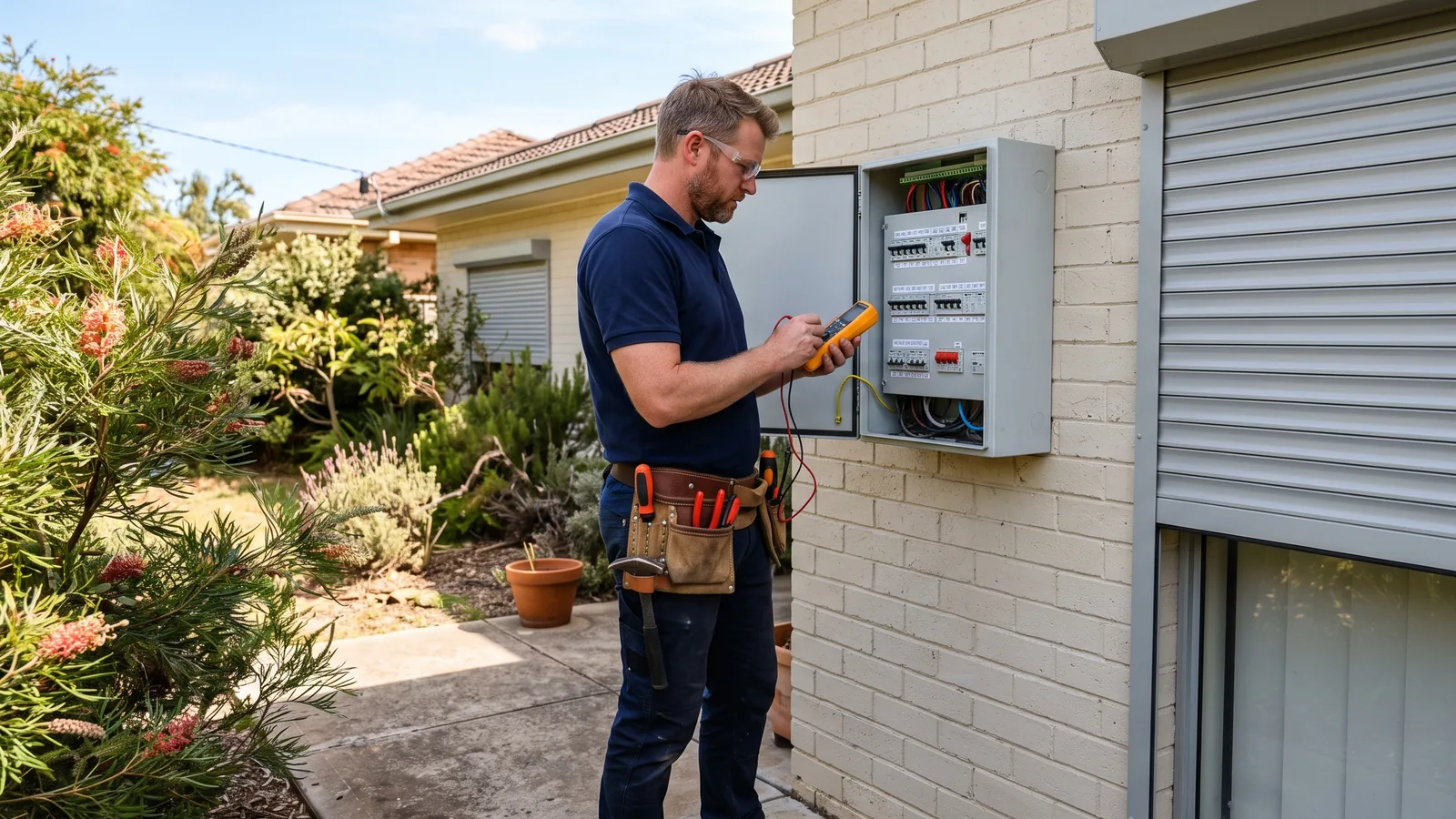
A roller shutter tripping the power can point to a motor fault, damaged wiring, moisture or excessive mechanical load. Stop operating it and leave the affected circuit off until the cause has been checked.
You press the button, the shutter starts to move, and the lights go out. Your switchboard's protective device has cut the supply, but the trip alone cannot tell you which part needs replacing.
For roller shutter repairs in Sydney, Fix My Shutters can assess the shutter and explain the repair options.
Before checking anything: stop using the shutter. If the switchboard is dry, undamaged and safely accessible, turn off the clearly labelled shutter circuit using its normal switch. Do not remove covers, touch exposed wiring or repeatedly reset a tripped device; if unsure which circuit supplies it, keep clear and call an electrician.
Your switchboard may have separate safety switches and circuit breakers, or combined devices. Which one tripped helps the electrician narrow the fault, but does not confirm a diagnosis.
An RCD (residual current device), also called a safety switch, detects an imbalance that can indicate electricity leaking to earth. A circuit breaker (MCB) protects against excessive current, including overloads and short circuits.
The Electrical Safety Office explains the difference between safety switches and circuit breakers, including combination devices. These are often called RCBOs and can trip for either type of fault.
Read only labels visible from the normal user-accessible front of the board. Do not remove its cover or press buttons to recreate the fault; a photo of the label can help when booking a repair.
A roller shutter motor draws more current when it fights excessive mechanical resistance. Dirty guide rails, bent slats, a jammed curtain or worn bearings can increase the load, although the motor's own protection may stop it before a switchboard breaker trips.
The shutter may have become slower over time, or started sticking at one point. Describe changes you noticed before the trip rather than running it again to demonstrate them.
Mention any unusual clicking noises from the roller shutter you heard before the trip. They may help the repairer locate a mechanical problem, although electrical testing is still needed.
If the shutter stops after repeated use while the rest of the circuit stays on, overheating protection is another possibility. Somfy explains that repeated motor operation can trigger thermal protection; follow the particular motor's cooling instructions. A switchboard trip still needs separate investigation.
Wiring faults can cause leakage or short circuits depending on the damage. A loose connection can also overheat without reliably tripping a protective device, so a breaker staying on is no guarantee that wiring is sound.
The fault could be in the supply cable, a junction box, the wall control or the motor connection. An electrician needs to distinguish these before anyone assumes the motor has failed.
Leave junction boxes and the shutter's motor enclosure closed. Turning a wall control off does not prove that the wiring inside is electrically isolated.
A trip after rain is a useful clue to possible water ingress, even when the housing looks intact. Water may enter through damaged seals or cable entries and affect insulation or electrical connections.
When booking shutter repairs across Sydney, mention whether the property is near the coast. Salt deposits and damp conditions can contribute to corrosion; how salt air damages roller shutters explains the wider signs to watch for around the shutter.
| Possible moisture source | What the repairer checks | Possible electrical effect |
|---|---|---|
| Rain through damaged seals | Motor housing and cable entries | Insulation breakdown or leakage |
| Condensation | Connections and control electronics | Leakage or short circuit |
| Damp, salty conditions | Connectors and junction boxes | Corrosion and deteriorating connections |
Weather timing does not prove the shutter is responsible; another outdoor appliance may share the circuit. Leave the shutter off even if it dries out, because a fault disappearing in dry weather does not show that it has been repaired.
A roller shutter can trip only when closing or only when opening. Mechanical loading changes with direction, but wiring, controls and motor faults can also behave differently between the two commands.
Bent slats, misaligned tracks or a catching bottom bar may cause resistance at a particular point. The direction and position are useful clues for a repairer, not proof that the problem is purely mechanical.
Do not repeat the trip to find the binding point. Describe what happened before you switched it off. Keep people away from a jammed or partly open shutter and do not force the curtain by hand.
Yes, it can be. Treat repeated trips as a fault requiring attention, even if the shutter works between episodes.
Never bypass a safety device or fit a larger breaker to stop tripping. Resetting a roller shutter motor is not a remedy for an electrical fault; leave reset procedures until the fault has been checked.
If there is smoke or fire, move away and call 000. For burning smells, visible cable damage or a wet switchboard, keep clear and seek urgent electrical help.
The aim is to separate a supply fault from a shutter fault before replacing parts. Depending on the installation, the diagnosis may include:
NSW Government requires an electrical licence or certificate for electrical wiring work, regardless of price. Ask who will carry out that work; our explanation of licensing requirements for roller shutter repairs helps distinguish electrical work from mechanical repairs.
Yes. Binding during closing is one possibility, but a direction-specific electrical fault is also possible. Leave it off and tell the repairer which command triggered the trip.
Electrical wiring work in NSW requires the appropriate electrical licence or certificate. A shutter repairer can assess mechanical issues, but fixed wiring and electrical fault repairs need a suitably licensed person.
Water entering electrical parts may cause leakage or a short circuit. Rain-related trips need investigation even if operation returns in dry weather; do not assume drying has fixed damaged seals or insulation.
The cost depends on whether the fault is in the wiring, controls, motor or shutter mechanism, plus access and water damage. Ask for a diagnosis and an itemised quote before approving a motor replacement.
Some underlying faults can overheat or arc. Stop using the shutter and do not bypass the protection or keep resetting it. Smoke or fire requires an emergency response.
A motor's thermal protection may stop movement after repeated operation while the household circuit stays on. Other control or mechanical faults can also stop a shutter; if it repeatedly stops during normal use, arrange an assessment.
Fix My Shutters has 15+ years of shutter repair experience and offers a fast response across Sydney. When booking, have these details ready:
Contact Fix My Shutters to request a free assessment and confirm availability. When booking, say if the shutter is stuck open or blocking access.
