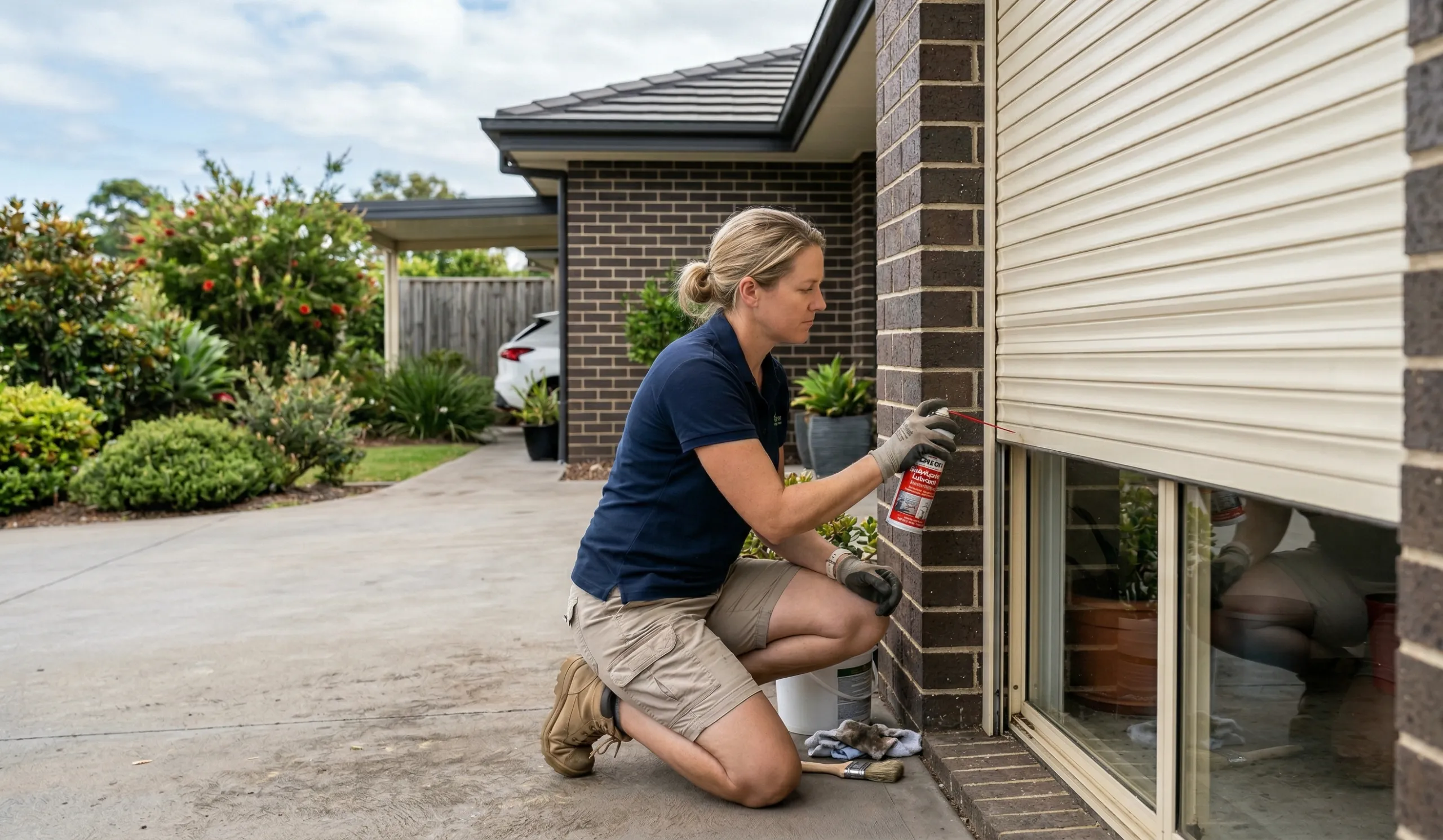
Silicone spray on the guide rails every six months keeps your roller shutters running smoothly.
Most roller shutter problems start with friction. Dirt builds up in the guide rails, salt air corrodes the tracks, and one morning the shutter sticks, grinds, or refuses to move at all.
This guide walks you through how to lubricate roller shutters properly, which products to use (and which to avoid), and the warning signs that mean lubrication alone won't fix the issue.
Related: Roller shutter repairs across Sydney | How to fix a jammed roller shutter
Roller shutters have metal slats running through aluminium or steel guide rails on both sides. Every time you open or close the shutter, those slats slide against the rails. Without lubrication, metal-on-metal contact creates friction, heat, and wear.
A well-lubricated shutter operates quietly and puts less strain on the motor. That means fewer breakdowns and a longer lifespan.
Over time, neglected rails lead to problems that cost real money to fix:
In Sydney, the problem accelerates faster than in most cities. Suburbs across the basin cop humidity and occasional salt-laden winds, and that moisture speeds up corrosion on unprotected metal surfaces. Regular lubrication creates a protective barrier between the metal and the elements.
Not all sprays are equal, and using the wrong one is worse than using nothing at all. Silicone-based spray is the best option for roller shutter guide rails. It repels moisture, doesn't attract dust, and works reliably across the temperature swings Sydney throws at your shutters from summer to winter.
| Lubricant Type | Verdict | Why |
|---|---|---|
| Silicone-based spray | Best choice | Repels moisture, doesn't attract dust, works in all temperatures |
| Dry PTFE spray | Good alternative | Leaves a thin dry film, ideal for dusty environments |
| White lithium grease | Axle/bearings only | Too heavy for guide rails, but ideal for barrel bearings and hinges |
| WD-40 (standard formula) | Avoid | A solvent and water displacer, not a long-term lubricant. Evaporates within days |
| Oil-based lubricants | Avoid | Attract dust and grit into the tracks, making the problem worse over time |
| Cooking spray or grease | Never use | Breaks down rubber seals, attracts insects, clogs tracks with sticky residue |
Look for products labelled "silicone lubricant" or "dry silicone spray" at your local hardware store. CRC and Inox both make reliable Australian options. A single can lasts most households a full year.
This is a 20-minute job and you don't need anything special. Gather everything before you start so you're not climbing up and down a ladder looking for a cloth.
No power tools, no disassembly required. If your shutter has an access panel for the barrel or motor housing, leave it closed for now. The guide rails and tracks are the primary parts you'll be spraying.
Follow these steps for each shutter. The whole process takes about 15 to 20 minutes per window, and you don't need any experience to get it right.
If your shutters are motorised, switch them off at the wall or isolate the circuit at the switchboard before you start. This prevents the shutter from activating while your hands are near the guide rails or barrel.
For manual shutters, secure the shutter in the fully open position so it can't drop while you work.
Wipe down both guide rails with a damp cloth to remove loose dirt and debris. For stubborn grime, use warm soapy water and a soft brush. Spraying lubricant over dirty rails just traps grit against the metal and speeds up wear.
Use a clean dry cloth to wipe the rails completely dry. Moisture trapped under the lubricant film can still cause corrosion, especially during humid Sydney summers.
Hold the can 10 to 15 centimetres from the rail and spray in short bursts along the full length. Work from top to bottom on both sides.
You want a thin, even coat. Pooling at the base of the rail means you've used too much.
Open and close the shutter fully at least three times. This distributes the lubricant across the full length of the slats and works it into the contact surfaces.
For electric shutters, reconnect power and use the normal controls. For manual ones, wind slowly and steadily.
Use a dry cloth to clean any overspray from the wall, windowsill, or glass. Silicone spray can leave marks on painted surfaces if left to sit.
Warning: Never spray lubricant directly onto the motor, electrical connections, or remote control receiver. Silicone can make plastic components brittle over time and may damage electrical contacts. Stick to the guide rails and mechanical parts only.
The guide rails are the most important part of routine maintenance, but other moving components benefit from occasional attention too.
Don't disassemble your shutter to reach internal components. If the barrel or motor housing needs servicing, that's a job for a qualified roller shutter repairer.
Manual and electric shutters need the same guide rail lubrication. The differences come down to frequency and what else needs attention.
| Factor | Manual Shutters | Electric Shutters |
|---|---|---|
| Lubrication frequency | Every 6 months | Every 6 months (every 3 if used daily) |
| Extra maintenance | Check spring tension annually | Check manual override still works |
| Strain from friction | You feel it (harder to wind) | Motor absorbs it (shortens motor life silently) |
| Safety step | Secure in open position | Disconnect power at the wall |
Electric shutters are more forgiving day-to-day because the motor masks friction you'd feel immediately on a manual winder. That's exactly why they need consistent lubrication. By the time an electric shutter starts making noise, the motor has already been working harder than it should for months.
For most Sydney homes, every six months is the right schedule. Twice a year, once before summer and once before winter, keeps things running smoothly through the temperature and humidity changes.
The Australian Government's YourHome guide recommends regular maintenance schedules for all moving parts of a home, and roller shutters are no exception.
Some situations call for more frequent attention:
A quick wipe and spray takes under 20 minutes. That small effort is far cheaper than replacing a burnt-out motor or damaged guide rails. If you're in Parramatta, Liverpool, Blacktown, or anywhere across Sydney, the same schedule applies.
After completing the process, a properly lubricated shutter should:
If the shutter still hesitates, makes noise at specific points in its travel, or feels heavy after fresh lubrication, the issue is mechanical. Bent slats, worn guide rails, or a failing motor can't be solved with silicone spray.
Getting this wrong can cause more damage than skipping it entirely. These are the mistakes we see most often when customers have tried to maintain their shutters themselves.
If you've already made one of these mistakes, don't panic. Clean the rails thoroughly with warm soapy water, dry them, and start fresh with the right product.
Sometimes a noisy or stiff shutter needs more than a spray. If you've lubricated properly and the shutter still grinds, sticks, or won't move smoothly, the issue is likely mechanical.
Lubrication only helps when the parts themselves are in good shape. Worn or damaged components need hands-on repair, not another coat of silicone.
Signs you need a professional:
These problems need proper diagnosis. A bent guide rail can't be fixed with silicone spray, and a failing motor will only get worse.
Fix My Shutters has been repairing roller shutters across Sydney for over 15 years. We see a lot of shutters that could have been saved with an earlier call.
WD-40 standard formula is not a lubricant. It's a water displacer and solvent that evaporates within days, leaving your guide rails unprotected.
Use a silicone-based spray or dry PTFE spray instead. WD-40 does make a dedicated silicone spray product, which is fine to use.
Squeaking, grinding, or resistance during operation are the clearest signs. If a manual shutter feels heavier than usual or an electric shutter sounds louder than it used to, friction is building up in the guide rails.
Yes, for the guide rails and external moving parts. Disconnect power on electric shutters first, wear safety glasses when spraying overhead, and never open the motor housing or touch electrical connections. If you need to access internal components, call a professional.
Friction builds steadily. You'll hear noise first, then the shutter starts sticking or moving unevenly.
On electric shutters, the motor works harder and burns out sooner. On manual shutters, you'll feel it get harder to wind. Eventually, the guide rails wear enough to need full replacement.
No. Never spray any lubricant directly onto the motor, wiring, or receiver unit. Silicone degrades plastic housings over time and can damage electrical contacts.
The motor is a sealed unit. If it needs servicing, that requires a qualified technician.
Yes. Salt air accelerates corrosion on aluminium and steel components. Coastal properties should lubricate every 3 to 4 months rather than the standard six-month schedule, and wipe down the rails more frequently to remove salt residue.
Lubricating your roller shutters is straightforward and it genuinely extends their life. Silicone spray, clean rails, a thin coat, and a consistent twice-a-year schedule. That's the whole formula.
But if your shutters are still giving you trouble after a proper lubrication, don't force it. Pushing a damaged shutter can turn a minor repair into a full replacement.
Get in touch with Fix My Shutters for a free assessment. We'll tell you exactly what's going on and what it'll cost to fix, no obligation.
