Find out what happens during a roller shutter service. Curtain inspection, guide checks, motor testing, lubrication and safety features covered step by step.
 Fix My ShuttersRoller shutter repairs, Sydney
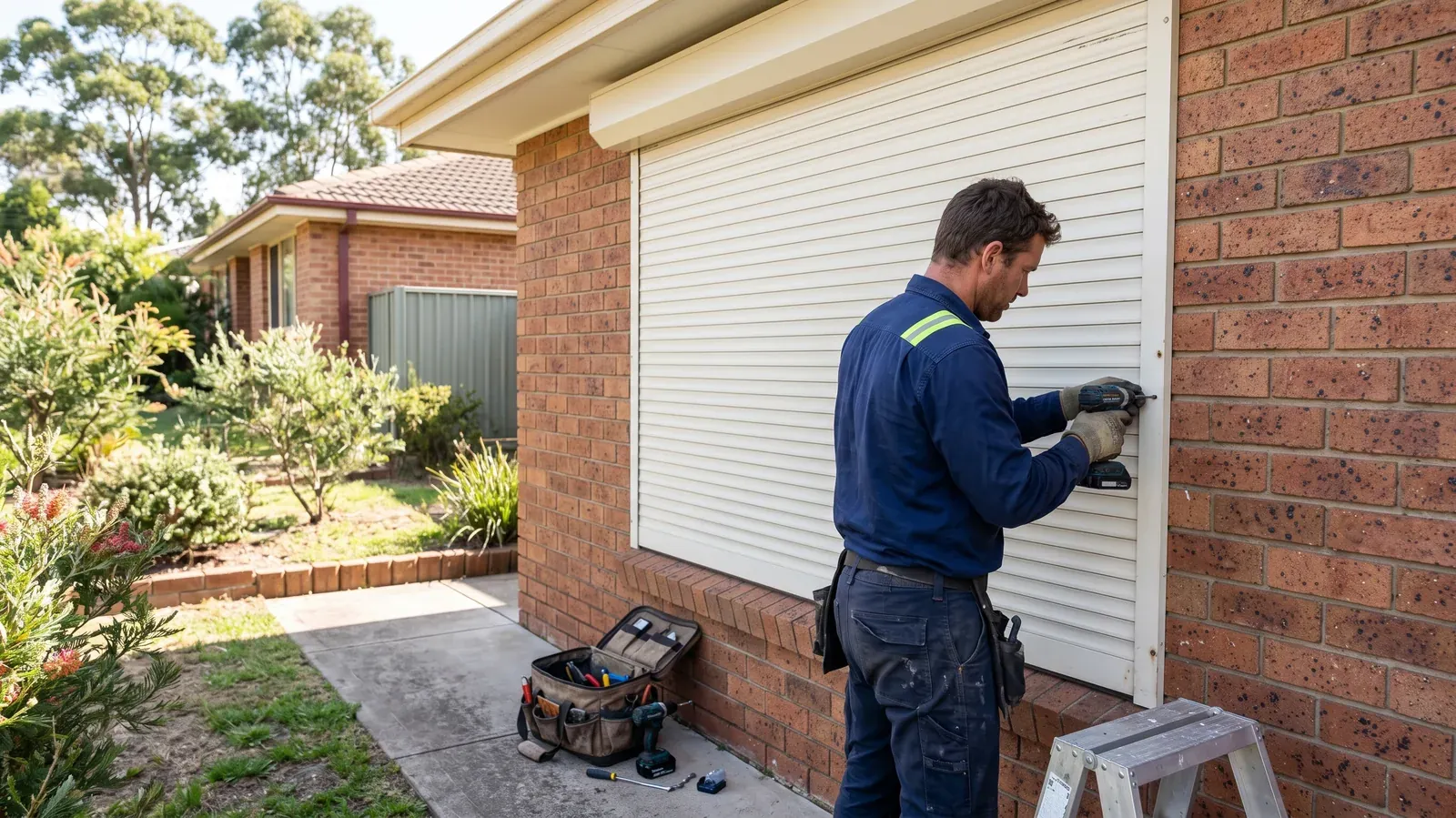
A roller shutter service checks every part that moves, locks or wears, in one visit.
Most homeowners run their shutters daily without thinking about what keeps them working. The motor strains, dust packs into the guides, bearings dry out, and one morning the shutter jams halfway down. A scheduled service catches those faults before they turn into a call-out.
This article walks through every step of a roller shutter service, from the initial curtain inspection to the final safety check, so you know exactly what you are paying for and why each part matters.
Need a roller shutter service in Sydney? Fix My Shutters services all brands across Sydney with 15+ years experience. Read more about annual safety checks or book a service call.
The service starts with a full visual inspection of the shutter curtain and slats. A technician runs the shutter through a complete open-close cycle, watching and listening for anything unusual. Grinding, scraping, rattling or uneven movement all point to specific faults that the rest of the service will investigate.
During this first pass, the technician is looking for:
Even minor slat damage changes how weight distributes across the barrel. A single bent slat forces the motor to work harder on every cycle, and that extra strain shortens motor life.
A technician can swap a damaged slat on the spot for around $30, whereas ignoring the problem until the motor fails pushes repair costs past $600. See our motor replacement cost breakdown for the full picture.
Side guides are the vertical channels the curtain rides in. When guides bend, corrode or come loose from their fixings, the shutter jams, makes noise, or travels unevenly. A technician inspects both guides top to bottom for wear, alignment and secure mounting.
Common guide problems found during a service include:
The bottom rail gets the same attention. It takes the most punishment because it contacts the ground on every close cycle. A worn or damaged bottom rail creates a gap at the base that compromises both insulation and security.
If guides are misaligned, the technician re-secures the brackets and adjusts the channel spacing. Badly corroded or bent guides get flagged for replacement rather than patched.
For electric roller shutters, motor and electrical testing is the most technical part of the service. The technician checks motor response time, listens for strain under load, and tests all control inputs: wall switches, remotes, timers and any smart-home integrations.
Limit settings are a common adjustment. These are the programmed stop points that tell the motor where "fully open" and "fully closed" sit. Limits drift over time as springs stretch and components settle.
A shutter that stops 20mm short of the ground, or bangs into the lintel at the top, usually just needs its limits reset.
The wiring and control box get a visual check for damaged insulation, loose terminals, moisture ingress and signs of overheating. The NSW Fair Trading electrical work guidelines apply here, so any wiring repair must be done by a licensed electrician. The manual override mechanism (usually a crank handle or chain) is tested to confirm it works in case of power failure.
| Service item | Manual shutter | Electric shutter |
|---|---|---|
| Curtain and slat check | Yes | Yes |
| Guide and track inspection | Yes | Yes |
| Spring tension adjustment | Yes | Sometimes |
| Motor response and load test | N/A | Yes |
| Limit setting adjustment | N/A | Yes |
| Remote and switch test | N/A | Yes |
| Manual override test | N/A | Yes |
| Lubrication | Yes | Yes |
| Safety sensor test | N/A | Yes (if fitted) |
If you have noticed warning signs that your motor needs attention, mention them to the technician before the service starts. It helps them focus on the right area.
Lubrication keeps bearings, springs, rollers and hinges moving freely and quietly. A technician applies silicone-based lubricant to every moving contact point. Silicone works best in Australian conditions because it does not attract dust or gum up in heat the way petroleum-based oils do.
The key lubrication points are:
More is not better here. Excess lubricant collects dust and forms a paste that grinds against moving surfaces. A professional applies a measured amount rather than flooding the mechanism.
If you want to top up lubrication between annual services, our guide on how to lubricate roller shutters yourself covers which spray to buy and where to apply it.
Modern electric shutters often include safety sensors that reverse the curtain when it hits an obstacle, a requirement covered under Safe Work Australia's plant and machinery guidelines. During a service, the technician places an object in the shutter's path and triggers a close cycle to confirm the sensor responds correctly. A sensor that fails this test is a safety risk, especially for households with children or pets.
Lock and latch mechanisms get a function check too. On manual shutters, this includes the bullet lock or key lock barrel. On electric shutters, the auto-lock engages when the curtain reaches the closed limit.
The technician confirms the lock seats fully and cannot be forced open by hand.
Security note: A roller shutter with a worn lock or a faulty auto-lock gives you the appearance of security without the substance. If the lock does not engage properly, get it fixed before it matters. Read more about roller shutter security checks.
Fixing a lock during a service visit typically costs less than a separate call-out, so it is worth raising any concerns on the day.
For residential shutters used daily, a service every 12 months keeps everything running. Shutters in high-use commercial settings, such as shop fronts or warehouse doors, benefit from a six-monthly schedule. Coastal properties where salt air accelerates corrosion should lean toward the shorter interval too.
Warning signs you are overdue for a service:
Any one of those is enough to pick up the phone. If you are seeing two or three at once, the shutter has gone too long without attention.
A routine service sits around $150, which is a fraction of what a seized motor or snapped spring costs to fix. Our repair cost guide breaks down the numbers for common jobs.
You do not need a technician for basic upkeep. Between annual services, a few simple habits keep your shutters in good shape and reduce the chance of unplanned repairs.
Anything beyond cleaning and listening should be left to a professional. Adjusting springs, resetting motor limits, or opening a control box without training risks injury or further damage.
Fix My Shutters services all of Sydney, from Parramatta to the coast, and carries parts for most brands so response times stay short. Check our full maintenance tips guide for the complete DIY checklist.
A single residential shutter typically takes 20 to 30 minutes. If you have multiple shutters serviced in one visit, allow roughly 15 to 20 minutes per additional shutter. Electric shutters with limit adjustments or sensor testing sit at the longer end.
Yes. Manual shutters still have springs, bearings, guides and locks that wear over time. The service scope is smaller because there is no motor or electrical system, but the curtain, guides and lubrication checks are identical.
Spring tension is especially important on manual shutters because a weak spring makes the shutter heavy and difficult to lift.
You can handle basic cleaning, hosing down the curtain and wiping the guides. Lubrication with a silicone spray is safe if you follow the correct method.
However, adjusting springs, resetting motor limits and working inside the control box should be left to a qualified technician. Springs under tension are a genuine injury risk.
Pricing varies by provider and how many shutters you have, but a single residential roller shutter service in Sydney typically ranges from $120 to $200. Multi-shutter discounts are common.
Prices are approximate market guides only and vary by system type, access difficulty and provider. Contact Fix My Shutters for an accurate quote.
A service identifies faults and handles minor adjustments like limit resets, lubrication and bracket tightening. If the shutter has a failed motor, snapped spring or damaged curtain section, that is a repair job rather than a service.
The technician will quote repair work separately during the visit. See our guide on fixing a jammed roller shutter for common repair scenarios.
Most roller shutter manufacturers require evidence of regular servicing to honour warranty claims. Skipping annual services can void your warranty on the motor and mechanical components. Check the documentation that came with your shutters, or ask the installer what servicing schedule the warranty requires.