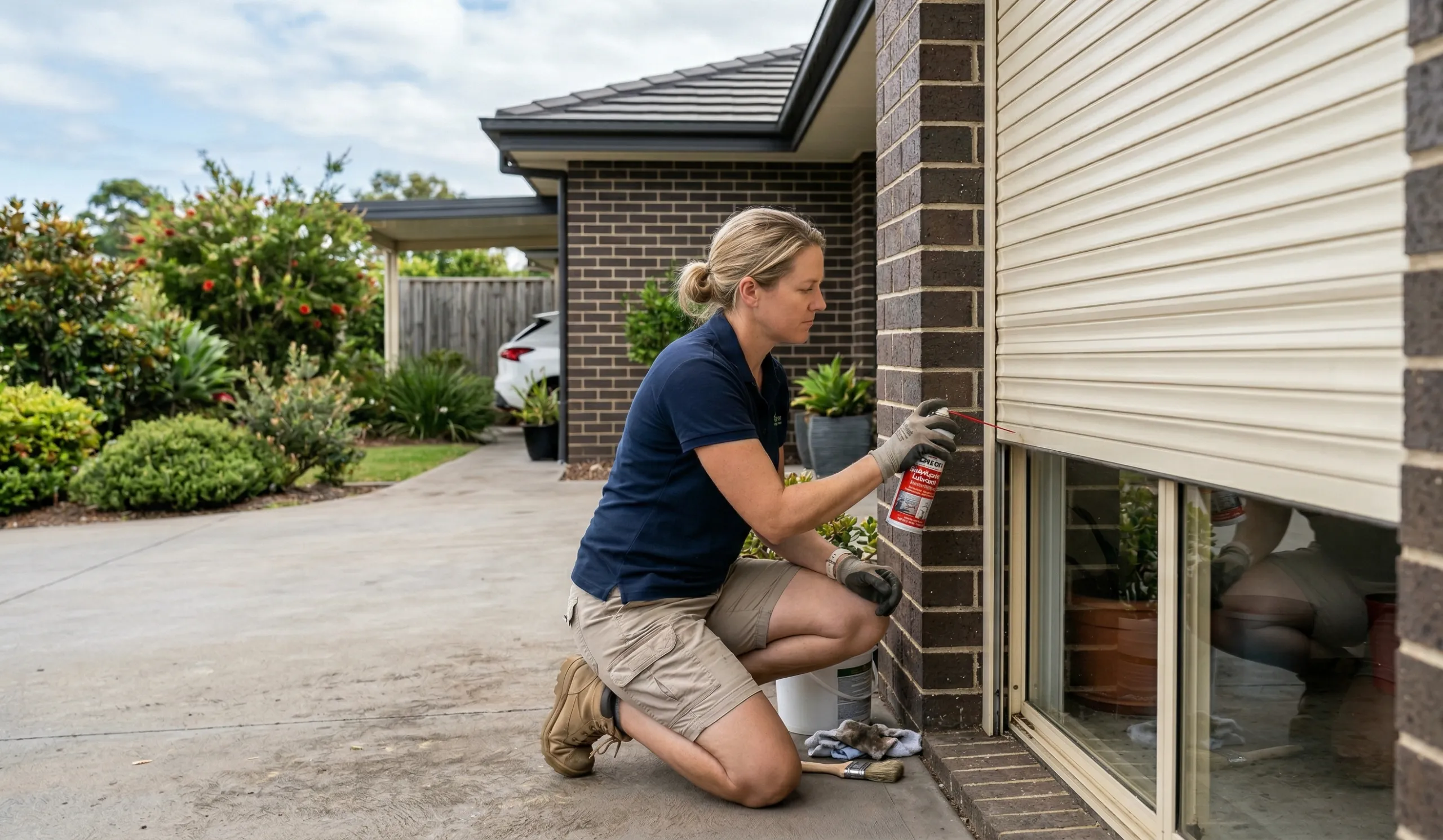
Childproofing your roller shutters for regular servicing takes about an hour and prevents the most common injuries kids have around them.
Young children treat shutters that won't stay in position like a toy. They press buttons, pull straps, poke fingers into window roller shutter guide rails, and stand underneath a moving shutter without understanding the danger.
The bottom bar of a powered shutter can apply enough force to knock a toddler down or trap small fingers.
This guide walks through the specific hazards manual and electric roller shutters pose to children and the practical steps to childproof roller shutters in your home. Every fix here is based on what we see during repairs across Sydney.
If your shutter is already malfunctioning, fix that first. A faulty shutter is more dangerous than one that works correctly. Start with our roller shutter repair guide or contact Fix My Shutters for help.
Roller shutters present several hazards that are specific to young children. The most serious risk is entrapment, where a child's fingers, hands, or clothing get caught in the guide rails or between the slats as the shutter moves. Powered shutters generate enough force to cause serious crushing injuries.
Children under five lack the reflexes to pull away quickly. The Australian Competition and Consumer Commission (ACCC) has flagged corded window coverings as a strangulation risk for decades, and while roller shutters differ from blinds, the same principles of cord safety apply to strap-operated models.
The Competition and Consumer (Corded Internal Window Coverings) Safety Standard 2014 makes cord safety devices mandatory on all new internal window coverings sold in Australia.
Beyond entrapment, children can activate a shutter by accident. Wall switches mounted at child height, remote controls left on tables, and strap winders that double as a pull toy all create opportunities for unsupervised operation.
None of these risks means you should rip out your shutters. They mean you should childproof roller shutters properly, and the fixes are straightforward.
Not every shutter in your home carries the same level of risk. Prioritise the rooms where children spend the most unsupervised time.
Work through the high-risk rooms first, then extend your childproofing to every window with a shutter. Most homes can be fully covered in a weekend.
The simplest way to childproof roller shutters is to stop children from operating them in the first place. This means securing every control point, whether it is a wall switch, a remote, a key switch, or a manual strap.
A lock-out switch or key-operated control is the single most effective childproofing measure you can install. It costs between $80 and $200 fitted, and it completely removes the child's ability to activate the shutter.
If you are not sure whether your shutter has a standard switch or a key switch, check the wall unit. A standard rocker switch has no lock. Our guide to testing your roller shutter's manual override covers how different control types work.
Finger entrapment is the injury Fix My Shutters technicians hear about most from parents. Children push their fingers into the gap between the guide rail and the slats, or into the spaces between slats while the shutter is moving.
The force of a powered shutter closing is enough to fracture small bones. Preventing this means either blocking access to pinch points or adding sensors that detect an obstruction and stop the shutter before damage is done.
The guide rails on either side of the window are the main danger zone. On older installations, these rails have an open channel that a child's finger fits into perfectly. Any bound opening between 8mm and 25mm at accessible height is considered a finger entrapment hazard under Australian building safety guidelines.
If your shutter is older and lacks modern safety features, a retrofit is worth the investment. Talk to a roller shutter specialist about which options suit your model.
Safety sensors are the most reliable childproofing upgrade for powered roller shutters. They detect when something is in the shutter's path and stop or reverse the movement automatically, without anyone needing to press a button.
The National Construction Code and AS 4140 set requirements for safety devices on powered doors and windows, and sensors are the primary way manufacturers meet those requirements.
| Sensor Type | How It Works | Best For | Typical Cost |
|---|---|---|---|
| Safety edge (pressure strip) | Detects physical contact on the bottom bar | Preventing crush injuries from the closing shutter | $200 to $400 fitted |
| Photoelectric beam | Infrared beam across the opening detects interruption | Detecting a person or object before the shutter reaches them | $250 to $500 fitted |
| Obstacle detection (motor-based) | Motor senses resistance increase during travel | Budget option built into newer motors | Included in motor replacement |
A safety edge sensor is the best option for most homes. It sits along the bottom bar and responds to direct contact, which is exactly where child injuries happen.
Photoelectric beams are useful for larger openings like garage shutters where you want detection before contact.
If your motor is more than 10 years old, it probably lacks built-in obstacle detection. Replacing an old motor often adds this feature automatically. Our guide to roller shutter motor replacement costs breaks down what is involved.
Manual roller shutters operated by a strap winder or crank handle have different risks compared to electric models. There is no motor to accidentally activate, but the strap itself is a strangulation hazard.
The spring tension inside the barrel can also cause the shutter to drop if the winder mechanism fails. The ACCC recommends that any looped cord or strap in a home with children under six should be secured so it cannot form a loop longer than 220mm at less than 1.6 metres above the floor.
The ACCC Product Safety guide warns that one to two children die in Australian homes each year from corded window covering accidents. Roller shutter straps carry the same strangulation risk as blind cords.
Use this room-by-room checklist to childproof roller shutters throughout your home. Work through each window that has a shutter and tick off the items below. Most of these take less than five minutes each.
Print this list or save it to your phone. Run through it once now and again every six months, especially after school holidays when kids are home more.
Roller shutters are safe when properly childproofed. The main risks are finger entrapment in guide rails, crushing from a closing bottom bar, strangulation from looped straps on manual models, and accidental activation of powered shutters.
Each of these hazards has a practical fix. A key switch, finger-safe guide rails, a safety edge sensor, and securing straps above 1.6 metres will address the most serious dangers.
Start before your child becomes mobile. Crawling babies can reach dangling straps, and toddlers can press low-mounted wall switches from around 12 months old. The ACCC specifically recommends cord and strap safety measures for homes with children under six.
By school age, most children can follow verbal rules about shutter safety, but the physical barriers (key switches, finger-safe rails) should stay in place until they are old enough to understand the consequences.
Basic childproofing starts at under $30 for a switch lock-out cover and a wall-mounted strap cleat. A key switch costs $80 to $200 fitted. Finger-safe guide rail retrofits run $150 to $300 per window.
A safety edge sensor, the most comprehensive upgrade, costs $200 to $400 fitted. For a typical home with four to six shutters, expect to spend $300 to $800 to cover the essentials.
AS 4140 sets safety requirements for powered doors and windows, including roller shutters, and covers safety devices like obstacle detection. The Competition and Consumer (Corded Internal Window Coverings) Safety Standard 2014 mandates cord safety devices on all new internal window coverings.
While existing roller shutters are not required to be retrofitted, the ACCC strongly recommends bringing older installations up to the safety standard, particularly in homes with young children.
You can handle several childproofing steps yourself. Installing a switch lock-out cover, mounting a strap cleat, securing remotes, and setting up baby gates are all DIY tasks.
However, fitting a key switch requires an electrician, and retrofitting finger-safe guide rails or a safety edge sensor involves working with the shutter mechanism. For these upgrades, a qualified roller shutter repair technician should do the work to ensure the shutter still operates correctly and meets Australian standards.
A safety edge sensor is a pressure-sensitive rubber strip that runs along the bottom bar of a powered roller shutter. When the bar contacts an obstruction, such as a child's hand, arm, or body, the sensor triggers the motor to stop immediately and reverse direction.
This prevents crushing and entrapment injuries. Safety edge sensors are considered the gold standard in child safety for powered shutters and cost $200 to $400 fitted.
You can handle most childproofing steps yourself, but a professional inspection catches the things you cannot see. Worn springs, degraded safety sensors, damaged guide rail channels and tracks, and motor faults all increase the risk to children.
Fix My Shutters services roller shutters across Sydney, from Parramatta to Penrith and the Blacktown area. If you want your shutters checked for child safety or need a sensor, key switch, or finger-safe guide rail fitted, get in touch for a quote.
